Dead Clade Walking. These three words shook the foundations of the scientific world several years ago. It relates to a theory which argues that some Dinosaurs survived the asteroid impact which triggered their extinction. Notably, the Dead Clade Walking theory did not argue that extinction did not occur, but rather that some Dinosaurs survived the... Continue Reading →
Media-Jacking or the Role of Media Events in the Digital Age
In the late 1980’s Daniel Dayan and Elihu Katz developed their theory of Media Events. They argued that certain high-profiled Media Events may have prolonged societal impacts. The two scholars were influenced by the historic visit of Egyptian President Anwar Sadat to Israel in 1977. Dayan and Katz argued that this Media Event altered the... Continue Reading →
Are Consular Tweets a New Form of Crisis Signaling?
When scholars and pundits discuss digital diplomacy, they tend to equate this term with social media activities. Indeed, the majority of digital diplomacy studies have focused on how and why social media is used by foreign ministries (MFAs), embassies, Ambassadors and International Organisations. Studies have explored the numerous ways in which states use sites such... Continue Reading →
“Follow-mies”- Is Diplomatic Reciprocity Binding in Digital Diplomacy?
Social media sites are predicated on the concept of reciprocity. When a user follows one of his peers, he expects his peer to respond in kind. The same is true with content engagement. The basis of social media is a social contract where users “Like” and “Share” one another’s content. Given that the ultimate goal... Continue Reading →
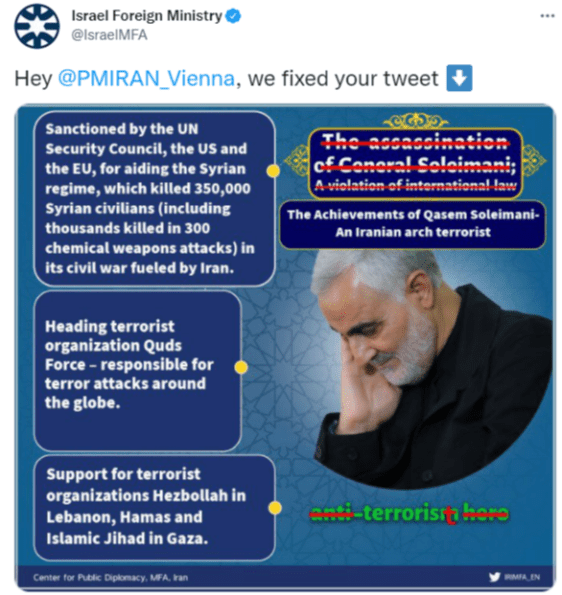
Israel Escalates Twitter Feud with Iran
Recent years have seen the mass migration of MFAs (foreign ministries) and diplomats to social media sites. It is now estimated that 95% of UN Member States have established some form of social media presence. Iran is no exception. Although Twitter, Facebook and other platforms cannot be accessed from Iran, senior Iranian policy makers can... Continue Reading →
A Season of Faith’s Perfection: Digital Diplomacy’s Greatest Year
The universe, as we now know, began with a bang. A big bang to be precise. A cataclysmic and cosmic explosion that at once gave birth to more than 120 billion galaxies. Digital diplomacy also began with a bang, or a momentous event that instigated a global change in the practice of diplomacy. This event, according... Continue Reading →
The End of the Charm Offensive? Iran on Social Media
The 2013 election of Hassan Rouhani as President of Iran was greeted with a global sigh of relief. Here was a clear indication that Iran was willing to rejoin the international community even at the cost of halting its nuclear weapons program. From the eve of his election, Rouhani was positively depicted in Western media... Continue Reading →
Is Digital Diplomacy A form of Liquid Diplomacy?
In the year 2000, Zygmunt Bauman introduced his theory of Liquid Modernity. Bauman argues that modernity (i.e., 18th-20th centuries) was characterized by solid social institutions such as nation states, with clearly marked borders, social classes, characterized by limited mobility, and fixed identities built around nations, religion or ethnicity. Late modernity, or the 21st century, is... Continue Reading →
The Metaverse and its impact on International Relations: A Summary
Two weeks ago, ICR Research, held a panel discussion on the future of the Metaverse and its impact on international relations. Bringing together scholars from the fields of digital diplomacy, cultural diplomacy, international relations and strategic communications, the panel sought to begin a wider debate on the implications of the Metaverse on states, diplomats and the... Continue Reading →
Is The Public a Problem in Public Diplomacy?
This blog post was first published on the CPD blog site and was co-authored by Alina Dolea and Cezar Jimenez Martinez Despite the many unprecedented restrictions that governments have imposed to contain the coronavirus pandemic, people all over the world—in places such as Chile, the United States, Lebanon, Hong Kong, Colombia, France, Brazil, the United... Continue Reading →