Over the past few weeks, several reports and publications have suggested that social media is entering a new era. The reason being that social media is increasingly becoming less social. During the early days of social media, millions of users would publish updates from their daily lives. Platforms such as Facebook, Twitter and Instagram were... Continue Reading →
Diplomacy in a World without Popular Culture
In recent years diplomats have increasingly employed pop culture in their digital communications. Some nations, for instance, celebrate Star Wars Day on May the 4th tweeting at their followers. Others employ pop culture memes when attempting to shape global public opinion. Countries such as Ukraine, Russia, Israel and the UK have all relied in popular... Continue Reading →
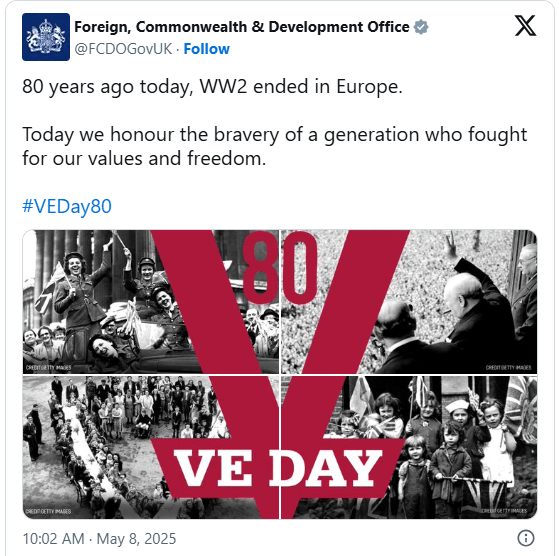
Digital Diplomacy and the Retelling of World War II
On May 8th, the world celebrated the 80th anniversary of the end of World War II. It was, for many, a solemn day. The end of World War II was meant to usher in a new dawn of stability and harmony amongst the nations of the world. The struggle to defeat Nazi Germany symbolized victory... Continue Reading →
Digital Diplomacy and the Crisis of Diplomatic Credibility
Diplomacy hinges on credibility. As Ben Mor aptly notes, “being perceived as honest and reliable is a necessary condition for obtaining and holding the attention of target audiences, as well as for effective persuasion.” States that are perceived as duplicitous or deceptive struggle to engage with global publics, let alone persuade them to accept their... Continue Reading →
Should I Stay or Should I Go? Diplomats and the X-odous
Note: This post was co-authored by Bar Fishman and Ilan Manor and was originally published on the USC CPD Blog. In recent years, the platform formerly known as Twitter, and now rebranded X, has lost millions of users. This process began following X’s acquisition by tech mogul Elon Musk during 2022. Musk’s contentious policies, which... Continue Reading →
Dual Use Terminology- Digital Diplomacy’s Dual Meaning
The term ‘dual-use technology’ is used to denote technologies that may have both civil and military applications. Such is the case with Global Positioning Systems or GPS which are used to help track and identify targets for missile attacks and are also used to help drivers navigate in cars. Another example is drones which may... Continue Reading →
Digital Diplomacy and the Beautification of War
Susan Sontag famously argued that photography was violent in nature. Photographs, according to Sontag, are violent as they fracture linear time. Each photograph is like an atom torn from linear time and forever frozen. The more photographs one takes, the more he or she rips linear time into fragments that can longer form a coherent... Continue Reading →
The Drone Wars: How Ukrainian Drones Are Reshaping War Coverage
In the early 1990s, scholars coined the term “The CNN Effect” referencing the impact that CNN had on American foreign policy. Scholars asserted that issues which rose to prominence in CNN were soon addressed by American policy makers. In this way CNN shaped the priorities of the White House and the State Department. CNN was... Continue Reading →
Is Digital Diplomacy Disruptive?
In a classic episode of the television show “Yes Prime Minister”, the Civil Servant Humphrey Appleby explains the logic of British diplomacy saying: “The Foreign Office is pro-Europe because it’s really anti-Europe. The civil service was united in its desire to make sure that the Common Market didn’t work. That’s why we went into it.... Continue Reading →
Diplomacy in the Age of Post-Reality
Last week, the Financial Times published an AI generated image of Presidents Putin and Trump kissing. The headline read “Fakes in the Post-Truth Era”. The term post-truth was first coined in 2016 by The Economist Magazine. The Economist was referring to the impact of social media on politics in general, and American politics in particular.... Continue Reading →