Note: This post was originally published as an Op Ed at E-International Relations. It was co-authored by Ilan Manor, Corneliu Bjola and Bar Fishman. On November 23, 2023, the mayor of Paris announced that she was leaving X, the network formerly known as Twitter. Citing a rise in a disinformation, hate speech, racism and “vicious... Continue Reading →
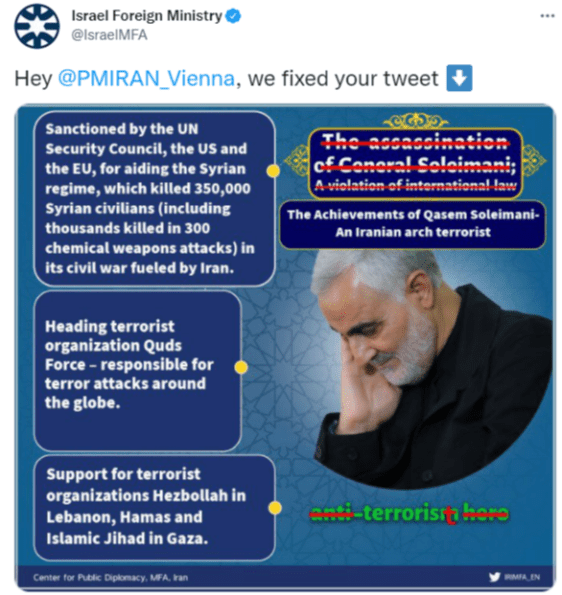
Israel Escalates Twitter Feud with Iran
Recent years have seen the mass migration of MFAs (foreign ministries) and diplomats to social media sites. It is now estimated that 95% of UN Member States have established some form of social media presence. Iran is no exception. Although Twitter, Facebook and other platforms cannot be accessed from Iran, senior Iranian policy makers can... Continue Reading →
Is Digital Diplomacy A form of Liquid Diplomacy?
In the year 2000, Zygmunt Bauman introduced his theory of Liquid Modernity. Bauman argues that modernity (i.e., 18th-20th centuries) was characterized by solid social institutions such as nation states, with clearly marked borders, social classes, characterized by limited mobility, and fixed identities built around nations, religion or ethnicity. Late modernity, or the 21st century, is... Continue Reading →
Covid’s Diplomatic Legacy
Last month, ‘The Economist’ magazine published an extensive article examining Covid’s impact on the practice of diplomacy. According to the article, the Coronavirus has led to the accelerated digitalization of diplomacy. Once the United Nations Headquarters shut its doors, and as diplomats all over the world found themselves quarantined at home, diplomacy migrated to digital... Continue Reading →
License to Tweet: When the Chief of MI6 Goes Online
License to Tweet: When the Chief of MI6 Goes Online In November of 2013, the Chief of MI6, the UK’s foreign intelligence service, joined Twitter. On the one hand, one could argue that the willingness of senior spies to join social networks is an important step forward in government transparency and accountability. Indeed, one could... Continue Reading →
Persoan Grata- An Interview with the Israeli MFA
This week I was interviewed for the Israeli MFA's podcast on digital diplomacy- Persona Grata. In this special episode of Persona Grata I talked with Yiftah Curiel who heads the Israel MFA's Digital Diplomacy department which manages more than 30 social media channels in 5 languages including English, Arabic, Farsi, Spanish, Russian and Hebrew. We discussed... Continue Reading →
The Digital Battle over News Headlines
When exploring digital diplomacy, scholars and practitioners tend to treat diplomacy as an island entire of itself. Some scholars, for instance, examine how digital tools facilitate diplomatic activities. Such is the case with virtual embassies that enable diplomats to foster ties with distant foreign populations. Other times scholars examine how digital tools complicate the practice... Continue Reading →
Preparing for the #Digital Future
Prof. Corenliu Bjola of the Oxford Digital Diplomacy Research Group recently concluded that the first stage of digital diplomacy has been a resounding success. Although MFAs are risk averse organizations who value discretion and shun from the limelight, they have successfully migrated to social media and adopted new communication practices that centre on information sharing,... Continue Reading →
From Magic Bullets to Bots: How Diplomats Conceptualize Social Media
Since the late 1930's communications scholars have investigated the influence of masa media on society. At times, scholars assumed that mass media such as radio and film had an immense impact on individuals and could manipulate their thoughts, beliefs and actions. At other times scholars assumed that the effects of mass media were cumulative and... Continue Reading →
Between National Brands and Leaders’ Brands
Last week British consultancy firm Portland Communications published its yearly Soft Power Index. The Index soon garnered global media attention as France ranked first trouncing America which had to settle for third place. According to Jonathan McClory, author of the Soft Power 30 report, France advanced to the first place thanks, in part, to the... Continue Reading →