Every few years, a new word seems to dominate societal discourses. In recent years the dominant word was “narrative”. New pundits depicted politics as a clash of narratives, diplomacy was understood as the practice of constructing appealing narratives, fake news and conspiracy theories were viewed as disruptive narratives that undermine trust in national institutions while... Continue Reading →
Practicing Diplomacy in the Attention Economy
Advertisers argue that attention is a finite resource. According to one study, individuals in the digital society are exposed to 8,000 advertisements a day. Given humans’ limited capacity for information processing, this barrage of advertisements is mostly ignored or forgotten within seconds. This means that if commercial brands are to compete successfully for the attention... Continue Reading →
Lecture- How the Digital Society Shaped Digital Diplomacy
On January 18, 2024, the European Digital Diplomacy Exchange, and the State Department, invited me to discuss my work on Digital Diplomacy. In this 45 minute lecture, I argue that in order to research digital diplomacy one must first research the digital society. This is because diplomacy is a social institution. When societies adopt new... Continue Reading →
Time to Regulate Social Media?
In his last recorded interview from 1986, astronomer Carl Sagan stated “We’ve arranged a society based on science and technology in which nobody understands anything about science and technology. And this combustive mixture of ignorance and power, sooner or later, is going to blow up in our faces”. The ignorance, and power, which Sagan was... Continue Reading →
The Power of Memes: Analyzing War-Time Messaging
The Russia-Ukraine war has witnessed the emergence of new social media practices. The Ukrainian government, for one, has been using social media to crowdfund its armed forces and create an IT army charged with cyber-attacks against Russia. Yet the war has also seen the growing use of memes. Ukrainian diplomats and government ministries have published... Continue Reading →
On the Metaverse: The Good, the Bad and Ugly
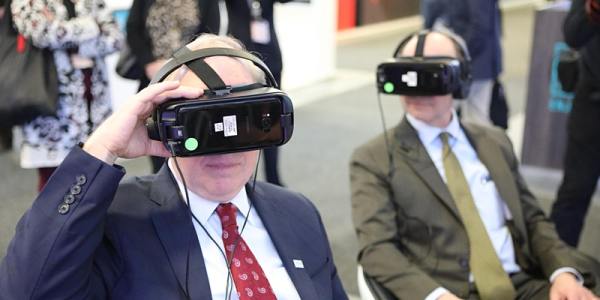
Two weeks ago, the Israeli Foreign Ministry and the Department of Communications at Ben Gurion University, held a one day workshop on the future of the Metaverse. The workshop explored how the Metaverse may impact society and diplomacy. Below, are my comments in which I call on diplomats to partake in shaping the vision of... Continue Reading →
License to Tweet: When the Chief of MI6 Goes Online
License to Tweet: When the Chief of MI6 Goes Online In November of 2013, the Chief of MI6, the UK’s foreign intelligence service, joined Twitter. On the one hand, one could argue that the willingness of senior spies to join social networks is an important step forward in government transparency and accountability. Indeed, one could... Continue Reading →
How External Shocks Alter Digital Diplomacy’s Trajectory
Some academics believe that digital diplomacy has developed in a linear fashion, and that each technological breakthrough (e.g., Facebook, AI) is accompanied by a process of implementation, adaptation and assimilation. Such scholars tend to focus on the attributes of any new technology while uncovering its potential use for diplomats. The fax machine, for instance, reduce... Continue Reading →
The Digital Battle over News Headlines
When exploring digital diplomacy, scholars and practitioners tend to treat diplomacy as an island entire of itself. Some scholars, for instance, examine how digital tools facilitate diplomatic activities. Such is the case with virtual embassies that enable diplomats to foster ties with distant foreign populations. Other times scholars examine how digital tools complicate the practice... Continue Reading →
From Magic Bullets to Bots: How Diplomats Conceptualize Social Media
Since the late 1930's communications scholars have investigated the influence of masa media on society. At times, scholars assumed that mass media such as radio and film had an immense impact on individuals and could manipulate their thoughts, beliefs and actions. At other times scholars assumed that the effects of mass media were cumulative and... Continue Reading →