Digital diplomacy is now entering its third decade. Having emerged circa 2008 with the establishment of virtual embassies in virtual worlds, digital diplomacy now includes the use of diverse technologies ranging from social media to messaging applications, blogs, smartphone applications, big data analysis, coding, websites, and even crowdfunding, as recently used by Ukraine. For policymakers,... Continue Reading →
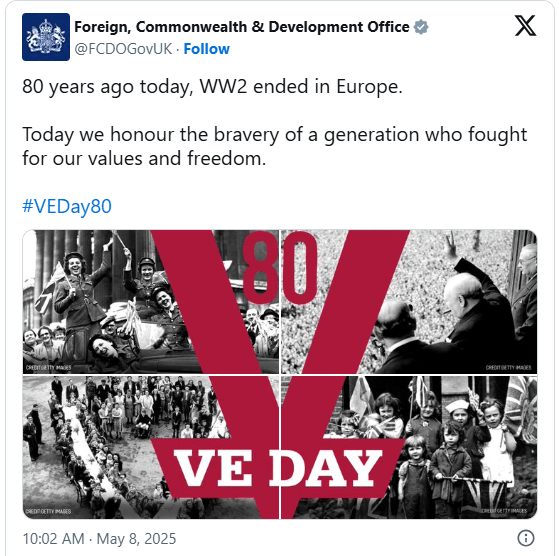
Digital Diplomacy and the Retelling of World War II
On May 8th, the world celebrated the 80th anniversary of the end of World War II. It was, for many, a solemn day. The end of World War II was meant to usher in a new dawn of stability and harmony amongst the nations of the world. The struggle to defeat Nazi Germany symbolized victory... Continue Reading →
Digital Diplomacy in the Age of Trump: An Analysis of “Rapid Response 47”
In January 2025, the Trump White House unveiled a new Twitter/X account titled “Rapid Response 47.” From the perspective of digital diplomacy, such an account may be of strategic importance. The ubiquity of social media, smartphones, and digital technologies has ushered in an era of instantaneous news dissemination and real-time crisis communication. In this dynamic... Continue Reading →
Digital Diplomacy and the Crisis of Diplomatic Credibility
Diplomacy hinges on credibility. As Ben Mor aptly notes, “being perceived as honest and reliable is a necessary condition for obtaining and holding the attention of target audiences, as well as for effective persuasion.” States that are perceived as duplicitous or deceptive struggle to engage with global publics, let alone persuade them to accept their... Continue Reading →
AI Power and its Impact on Digital Diplomacy Research
Throughout the 1980s, noted British historian Eric Hobsbawm delivered a series of lectures examining the academic study of history, and the state of social history, his chosen field. Hobsbawm’s lectures offer much needed insight into the study of digital diplomacy, in general, and the study of AI’s potential impact on diplomacy. For example, Hobsbawm argued... Continue Reading →
On DeepSeek, AI and “Post-Time”
Sociologist Manuel Castells famously argued that digital societies relentlessly strive to annihilate time and space. Time is annihilated by the reversal of traditional roles and life experiences. Such is the case with a 30-year-old tech CEO that manages 50-year-old employees or in the view of retirement as a second adolescence, a period of experimentation, of... Continue Reading →
ChatGPT and the Future of Diplomacy – Part 3
In recent weeks I have begun to explore how ChatGPT, a generative Chatbot created by Open AI, may impact the work of diplomats and diplomatic institutions. One blog post examined how ChatGPT may help diplomats automate the creation of texts ranging from social media posts to addresses at the UN. A second blog post examined... Continue Reading →
Estonia, War Monuments and Strategic Communications
In 2014, Russia launched a stealth invasion of Ukraine. Resulting in the annexation of Crimea, the 2014 invasion saw the mass utilization of social media by Russian state authorities, the Russian foreign ministry and Russian diplomats. Russia’s digital communications rested on four arguments. First, that the democratically elected Ukrainian President Viktor Yanukovych was ousted from... Continue Reading →