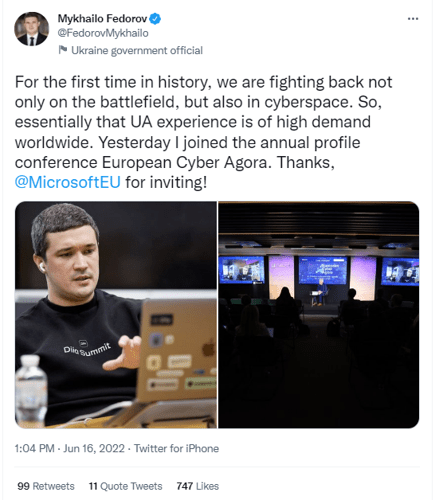
It is often said that practice makes perfect. While Ukraine’s digital diplomacy is not perfect, the Ukrainian government has gained valuable expertise in using digital technologies. Indeed, since the beginning of the Russia-Ukraine War, Ukraine has employed a host of innovative digital tactics. These include the creation of a hacker army; crowdfunding aid for its... Continue Reading →
Monday’s Must Read List

Each week, I publish a list of interesting articles, essays and reports that may be of interest to the digital diplomacy community. This week – Dozens of Israeli business and tech figures visit Saudi Arabia (Times of Israel)Students work to solve pressing technology challenges, maintain NATO’s technological edge (NATO)An inclusive future? Technology, new dynamics, and... Continue Reading →
Media-Jacking or the Role of Media Events in the Digital Age
In the late 1980’s Daniel Dayan and Elihu Katz developed their theory of Media Events. They argued that certain high-profiled Media Events may have prolonged societal impacts. The two scholars were influenced by the historic visit of Egyptian President Anwar Sadat to Israel in 1977. Dayan and Katz argued that this Media Event altered the... Continue Reading →
Monday’s Must Read List
Each week, I publish a list of interesting articles, essays and reports that may be of interest to the digital diplomacy community. This week – Technology policymaking in India: The need for a paradigm shift (ORF Website)The essential role of AI in cloud technology (Tech Radar)The biggest tech trends to watch for in 2022 (The Washington... Continue Reading →
“Follow-mies”- Is Diplomatic Reciprocity Binding in Digital Diplomacy?
Social media sites are predicated on the concept of reciprocity. When a user follows one of his peers, he expects his peer to respond in kind. The same is true with content engagement. The basis of social media is a social contract where users “Like” and “Share” one another’s content. Given that the ultimate goal... Continue Reading →
Monday’s Must Read List
Each week, I publish a list of interesting articles, essays and reports that may be of interest to the digital diplomacy community. This week – Americans widely distrust Facebook, TikTok and Instagram with data, poll finds (The Washington Post)The Metaverse already has a groping problem (MIT Technology Review)How America Can Keep Its Lead in Technology (Wall... Continue Reading →
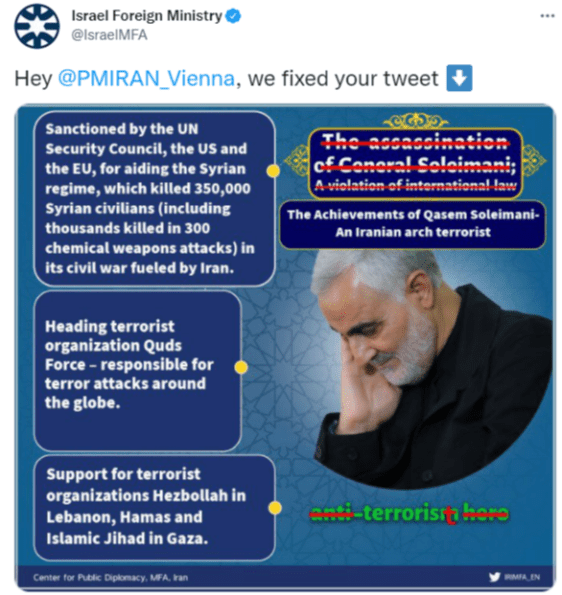
Israel Escalates Twitter Feud with Iran
Recent years have seen the mass migration of MFAs (foreign ministries) and diplomats to social media sites. It is now estimated that 95% of UN Member States have established some form of social media presence. Iran is no exception. Although Twitter, Facebook and other platforms cannot be accessed from Iran, senior Iranian policy makers can... Continue Reading →
Mondays’ Must Read List
Each week, I publish a list of interesting articles, essays and reports that may be of interest to the digital diplomacy community. This week- The 20 Most Promising Israeli Startups to Follow in 2021 (Haaretz Newspaper)WSJ’s deep dive into eating disorder on TikTok explains a sudden policy change (The Verge)What is the metaverse? (BBC News)Could... Continue Reading →
Monday’s Must Read List
Each week, I publish a list of interesting articles, essays and reports that may be of interest to the digital diplomacy community. This week- How Israeli Spy-tech Became Dictators' Weapon of Choice (Haaretz Newspaper)The opportunities that geospatial technology presents for India Inc. (The Economic Times)We don’t yet have the technology needed to reach net zero... Continue Reading →
Is Digital Diplomacy A form of Liquid Diplomacy?
In the year 2000, Zygmunt Bauman introduced his theory of Liquid Modernity. Bauman argues that modernity (i.e., 18th-20th centuries) was characterized by solid social institutions such as nation states, with clearly marked borders, social classes, characterized by limited mobility, and fixed identities built around nations, religion or ethnicity. Late modernity, or the 21st century, is... Continue Reading →