Monday’s Must Read List

Each week, I publish a list of interesting articles, essays and reports that may be of interest to the digital diplomacy community. This week – What on Earth is Happening in Ukraine (The Jerusalem Post)Truth Social: Banned from Twitter, Trump returns with a new platform (BBC News)What's the Most Dangerous Emerging Technology? (Gizmodo)How big technology systems... Continue Reading →

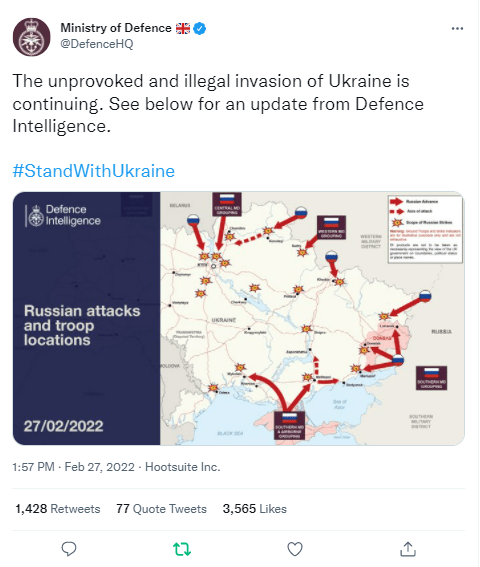
What on Earth is Happening in Ukraine?

Yesterday I set out to understand the current state of affairs in Ukraine. The day began, as always, with a barrage of memes mocking a meeting between Russian President Putin and Russian Foreign Minister Sergey Lavrov. The news was not all bad. Though the two gentlemen seemed distanced, Lavrov emphasized that there may still be... Continue Reading →

Monday’s Must Read List

Each week, I publish a list of interesting articles, essays and reports that may be of interest to the digital diplomacy community. This week – Google, Meta and Amazon are on track to absorb more than 50% of all ad money in 2022 (DIGIDay)Facebook Has a Superuser-Supremacy Problem (The Atlantic)Seven ways to protect your child’s privacy... Continue Reading →

Are Consular Tweets a New Form of Crisis Signaling?

When scholars and pundits discuss digital diplomacy, they tend to equate this term with social media activities. Indeed, the majority of digital diplomacy studies have focused on how and why social media is used by foreign ministries (MFAs), embassies, Ambassadors and International Organisations. Studies have explored the numerous ways in which states use sites such... Continue Reading →

Monday’s Must Read List

Each week, I publish a list of interesting articles, essays and reports that may be of interest to the digital diplomacy community. This week - Two-thirds of Ultra-Orthodox Israelis are online, COVID driving them to tech training (Times of Israel)How Russia tries to censor Western social media (BBC News)The worst technology of 2021 (MIT Technology Review)India... Continue Reading →

Is Digital Diplomacy A form of Liquid Diplomacy?

In the year 2000, Zygmunt Bauman introduced his theory of Liquid Modernity. Bauman argues that modernity (i.e., 18th-20th centuries) was characterized by solid social institutions such as nation states, with clearly marked borders, social classes, characterized by limited mobility, and fixed identities built around nations, religion or ethnicity. Late modernity, or the 21st century, is... Continue Reading →

Effective Government Communication During Covid19: What Governments Can Learn from Diplomats

A recent article in Nature, titled "Toward effective government communication strategies in the era of COVID-19", outlines communications policies that may help governments face the Covid-19 pandemic. The authors layout 9 guiding principles for "effective" government communication, including clarity, honesty and empathy. It is interesting that most of these principles are relevant to digital diplomacy,... Continue Reading →

Blog at WordPress.com.

Up ↑