At a recent international conference I was asked- how does relationality help understand public diplomacy in today’s world? To answer this question, we must first characterize todays’ world. It is a world that is prone to crises, a world that is marked by wars, it is a complex world as a crisis in one world... Continue Reading →
Media-Jacking or the Role of Media Events in the Digital Age
In the late 1980’s Daniel Dayan and Elihu Katz developed their theory of Media Events. They argued that certain high-profiled Media Events may have prolonged societal impacts. The two scholars were influenced by the historic visit of Egyptian President Anwar Sadat to Israel in 1977. Dayan and Katz argued that this Media Event altered the... Continue Reading →
Has strategic communications reduced political extremism to an information problem?
In a recent publication I have argued that investigating the employment of digital technologies in diplomacy requires that one regard digitalization as a long term process. The reason for this is that new digital technologies constantly emerge bringing with them new opportunities and challenges. Moreover, digital technologies often necessitate that diplomatic institutions adopt new norms... Continue Reading →
In Digital Diplomacy, Hope Travels Further Than Hate
Recent years have seen ministries of foreign affairs (MFAs) adopt a strategic approach to their digital communications. As part of this approach, MFAs create narratives, or frames, through which digital publics can make sense of events shaping their world. Scholars such as Ben O’Loughlin, Alister Miskimmon and Laura Roselle argue that narratives are powerful as... Continue Reading →
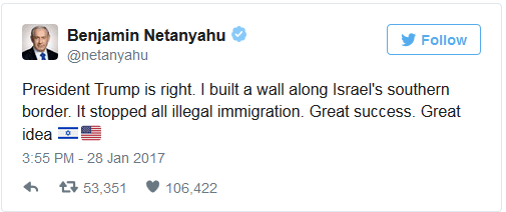
What’s in a Tweet? The Case of Benjamin Netanyahu and the Mexican Wall
Yesterday evening I was interviewed on an Israeli radio show regrading a recent tweet published by Israeli Prime Minister Benjamin Netanyahu. In this tweet the PM argued in favour of the construction of a wall between the US and Mexico. As usual, I was asked “What’s in a Tweet?”, or how much information can we... Continue Reading →