Each week, I publish a list of interesting articles, essays and reports that may be of interest to the digital diplomacy community. This week- 'Digital poverty' could lead to lost generation of university students, vice-chancellors say (The Guardian)American Airlines Is The First US Carrier To Use Digital Health Passport (Flying Simple)China Envisions Digital-Currency Future, With... Continue Reading →
Twitter and Diplomatic Signaling: The Case of Joe Biden
Two week ago, I analyzed the speed with which world leaders employed Twitter to congratulate Joe Biden on his election. Indeed, within two hours of CNN’s projection of a Biden victory, more than twenty world leaders tweeted at the President elect. These included the leaders of Germany, Canada, the UK, Norway, France, Sweden and the... Continue Reading →
Russia’s Digital Kiev Offensive
World War 2 (WW2) features prominently on social media. Dates of important battles are commemorated by many European nations. Foreign ministries (MFAs) also memorialize brutal occupations and celebrate eventual liberations. For some, WW2 is an integral part of national narratives, as is the case with Israel and Poland. While the former claims to have been... Continue Reading →
The New Aesthetics of Leaders’ Images
Images of leaders have always played an important role in politics. Images can capture the supremacy of a king, the daring of a field marshal or the cunning of a shrewd politician. Indeed, Napoleon’s portrait, sitting upon a fiery steed and pointing to the alps, captures his audacity and ambitions. Yet images of world leaders... Continue Reading →
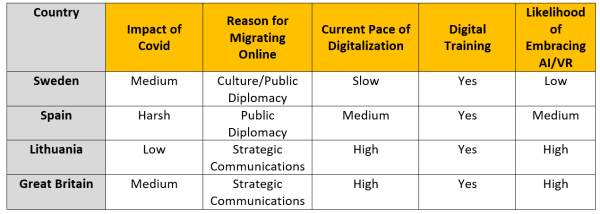
How Will Covid19 Impact Diplomacy’s Digitalization?
When researching digital diplomacy, one soon realizes that every foreign ministry (MFA) has undergone a unique process of digitalization. The digitalization of the US State Department rested, among other, on the appointment of two digital enthusiasts- Alec Ross and Jared Cohen. Canada’s digitalization was facilitated by a change in administration as the Trudeau government urge... Continue Reading →
Digital Diplomacy & Existential Threats
The Covid virus is not likely to kill mankind. The majority of Covid patients survive, youngsters seem more immune to its potency, and scientific and medical collaborations will ultimately yield a vaccine. However, Covid’s side effects, namely anxiety and disorientation, are evident everywhere. In Israel, TV viewers are told that the rate of contamination has... Continue Reading →
How External Shocks Alter Digital Diplomacy’s Trajectory
Some academics believe that digital diplomacy has developed in a linear fashion, and that each technological breakthrough (e.g., Facebook, AI) is accompanied by a process of implementation, adaptation and assimilation. Such scholars tend to focus on the attributes of any new technology while uncovering its potential use for diplomats. The fax machine, for instance, reduce... Continue Reading →
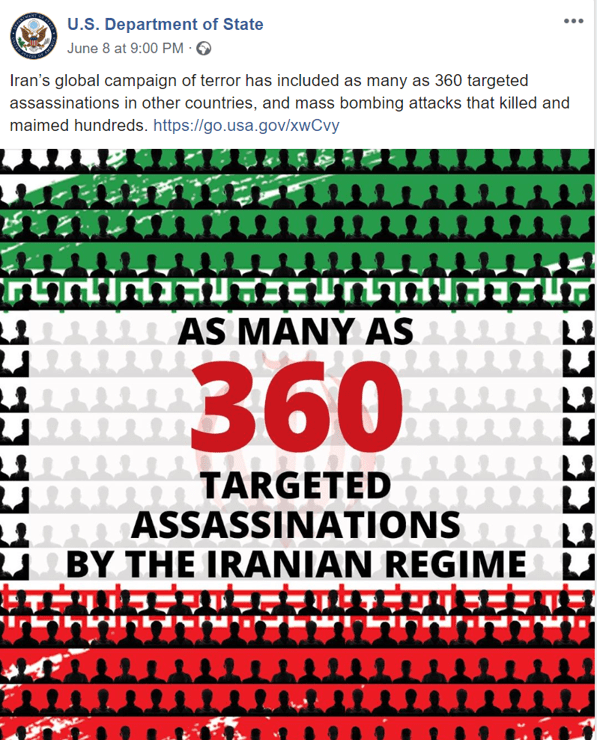
Crafting Digital Diplomacy Campaigns: How America’s Iranian Campaign is Backfiring
The Value of Facebook Comments When reviewing the US State Department’s Facebook account, it becomes apparent that the Department is in the midst of two digital campaigns. The first focuses on China’s alleged misconduct during the Covid19 outbreak. The second argues that Iran’s nefarious activities in the region, and the world, must be met by... Continue Reading →
Leveraging Big Data During Pandemics
Last week I had the opportunity to interview a software analyst working for one of the world’s most popular search engines. The analyst is part of a crisis response unit whose main task is to offer answers to Covid related queries. To do so, the crisis response team must gather reliable information from all over... Continue Reading →
What Embassies Tweet About During COVID-19
Diplomacy is not immune to the Covid-19 virus. For the first time since the 17th century, diplomats and world leaders no longer meet face-to-face to address shared challenges or resolve shared grievances. The UN is closed, the WTO is out of session and G7 meetings take place through video conference calls. Embassies, traditionally tasked with... Continue Reading →