Last week, the Financial Times published an AI generated image of Presidents Putin and Trump kissing. The headline read “Fakes in the Post-Truth Era”. The term post-truth was first coined in 2016 by The Economist Magazine. The Economist was referring to the impact of social media on politics in general, and American politics in particular.... Continue Reading →
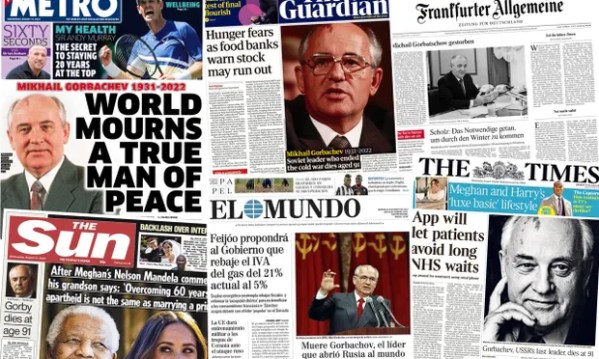
Framing Gorbachev: How World Leaders Reacted to the Death of Mikhail Gorbachev
On Wednesday, August 31st, it was announced that former Soviet leader Mikhail Gorbachev died aged 91. As is the case with any major event, different news outlets narrated Gorbachev’s differently. Newspapers, websites and bloggers all adopted different narratives, or frames when depicting Gorbachev . For instance, the BBC headline read “Mikhail Gorbachev: Last Soviet leader... Continue Reading →
Monday’s Must Read List
Each week, I publish a list of interesting articles, essays and reports that may be of interest to the digital diplomacy community. This week- Afghan women hit back at Taliban with #DoNotTouchMyClothes campaign (BBC News)Game changer: The first Olympic games in the cloud (MIT Technology Review)China’s Technology Workers Get Unions (Voice of America)The next chapter... Continue Reading →
How Chinese Ambassadors Use Twitter
In my 2019 book, The Digitalization of Public Diplomacy, I dedicated a chapter to Ambassadors’ use of Twitter. My assertion was that Ambassadors may be viewed by digital publics as trusted sources of information. This is because Ambassadors have privileged access to information, they have access to the highest echelons of power, they are viewed... Continue Reading →
Narrative Realignment & the Holy Grail of Digital Diplomacy
How to prove the efficacy of digital diplomacy activities? This question has plagued diplomats and scholars for nearly a decade. Diplomats have had to prove the efficacy of digital activities in order to ensure the very existence of digital diplomacy departments. Unlike any other desk or department, diplomats have had to demonstrate that digital diplomacy... Continue Reading →
The Digital Battle over News Headlines
When exploring digital diplomacy, scholars and practitioners tend to treat diplomacy as an island entire of itself. Some scholars, for instance, examine how digital tools facilitate diplomatic activities. Such is the case with virtual embassies that enable diplomats to foster ties with distant foreign populations. Other times scholars examine how digital tools complicate the practice... Continue Reading →
The Growing Importance of Journalists in Diplomacy
In 1986 a new press attaché was appointed to the Israeli Embassy in London. His first task was to establish close working relationships with the editors of Fleet Street, the home all major British newspapers at the time. One of the attaché’s most important meeting was with the journalist writing the editorials for the Times... Continue Reading →
Do MFAs Really Attract Journalists on Social Media?
Some have traced the origins of digital diplomacy to America's need to counter Al-Qaeda's online narrative and recruitment efforts. As Ellen Hallams has written, already in 2008 it was estimated that the internet was responsible of 80% of recruitment of Jihadi movements. In an attempt to stem the tide of recruitment, and counter Al-Qaeda's narrative... Continue Reading →
Is the Backstage of Diplomacy Disappearing?
20th Century Diplomacy For most of the 20th Century, diplomacy was practiced behind iron curtains. While diplomats would often pose for photo opportunities, such photographs were taken before and after their meetings. The diplomatic deliberations themselves took place within the inner sanctums of great palaces or behind the closed doors of historic halls. It was... Continue Reading →
Real Time Diplomacy?
Philip Seib argues that the advent of social media and social networking sites have brought about a new form of diplomacy, one that must contends with global events taking place in real time. In an age when a single video documenting the brutal oppression of a demonstration circles the globe within hours, foreign ministries are... Continue Reading →