In November of 2016, Oxford dictionary proclaimed “Post Truth” the 2016 word of the year. The choice was obviously a reflection of two important political campaigns- Brexit and the US Presidential elections. In both campaigns truth became subservient to political gains while the distinction between fact and fiction eroded. Exaggerations, fabrications and lies became an... Continue Reading →
On the use of images in the diplomatic struggle over Syria
Two weeks ago I published an analysis of the images of Syria used by the British FCO on Twitter. My analysis found that the FCO employs images that resonate with iconic moments from British history. In addition, I found that these images are an integral part of the British narrative of events in Syria. This... Continue Reading →
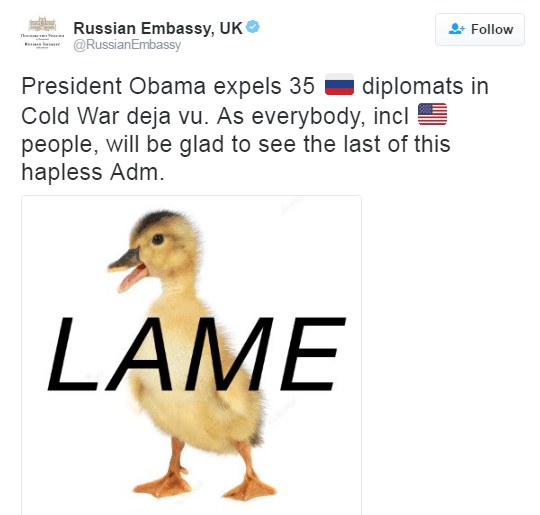
The Russian Tweet Heard Around the World
On Thursday, the 29th of December 2016, President Barack Obama announced the expulsion of 35 Russian diplomats from the US as well as new economic sanctions targeting Russia's intelligence agencies. Both measures were part of the American response to Russia's alleged interfering in the 2016 Presidential elections. Russia's digital response was immediate. Within an hour... Continue Reading →
On the use of narratives and images in Digital Diplomacy
Despite recent debates on fake news and the virility of rumors and gossip, it is important to remember that social media users are intelligent, curious and eager to learn about events shaping their world. More specifically, digital diplomacy followers are often interested in insight and analysis of global events. For this reason, narratives may play... Continue Reading →
Selfie Diplomacy- Analyzing Profile Pictures of World Leaders on Twitter
Last week I published an analysis of the Twitter profile pictures of MFAs (ministries of foreign affairs). I argued that such images may be a form of Selfie Diplomacy as profile pictures enable social media users to construct an online identity and communicate that identity to their networks. This week I endeavored to analyze the... Continue Reading →
Is NATO Sending Russia Mixed Signals on Social Media?
The majority of academic articles suggest that MFAs (ministries of foreign affairs) migrated to social media given a desire to converse and shape the opinions of online publics. However, recent studies also suggest that MFAs now use twitter to disseminate and gather information that may be of use to foreign policy makers and analysts. Indeed... Continue Reading →
How Russia Practices Digital Diplomacy- Interview with Press Attaché at Russian Embassy In London
Over the past year, much has been written about Russian digital diplomacy. While some have argued that Russia uses social media for propaganda, analysis has shown that the Russian MFA is one of the most active and dominant foreign ministries on twitter. Moreover, the Russian MFA is one of the most central ministries among the... Continue Reading →
Is Digital Diplomacy Just Theatre?
Sociologist Erving Goffman separates the realm of social life into two distinct spheres: the front, in which people play certain roles, and the back region or backstage in which their true character lies. It is in the back region where the illusion portrayed onstage is meticulously prepared. According to Goffman, credibility is key to human... Continue Reading →
What can we learn from digital diplomacy?
One of the major questions arising from the study of digital diplomacy deals with its practical application. In other words, what can we really learn from digital diplomacy? In the past, I have conducted several analyses which suggest that MFAs now routinely follow one another on twitter. As such, MFAs may be using social media... Continue Reading →
The State of Russian Digital Diplomacy- Part 3
Over the past two weeks, I have published two posts dealing with Russia's digital diplomacy apparatus. While the first post focused solely on Russia's digital diplomacy reach, the second post compared between the social media reach of the US and Russia. However, both posts dealt primarily with the extent to which the US and Russia... Continue Reading →