To Download the Conference Summary Report click here (Digital Diplomacy Conference Summary_Final) On the 30th of March, 2016, the Israeli Foreign Ministry and the Partner Institute at Tel Aviv University co-hosted Israel’s first Digital Diplomacy conference. Attended by 50 diplomats from 20 countries, alongside scholars from 25 universities, the conference aimed to investigate the impact... Continue Reading →
The UK as a Russian Battleground State
Since its emergence nearly a decade ago, digital diplomacy has been accompanied by a need to justify its costs. This is due to the fact that senior diplomats and policy makers often regarded digital diplomacy as a fad rather than a strategic tool for achieving foreign policy goals. This negative view of digital tools led... Continue Reading →
The Digitalization of Diplomacy
Digital diplomacy is no longer a novel phenomenon. In one form or another, digital diplomacy has existed for more than a decade. And yet scholars and practitioners continue to explore the practice and definition of digital diplomacy. During this process, different scholars and MFAs have offered different terms to understand the utilization of digital tools... Continue Reading →
How Embassies Managed the London Terror Attack
The horrid attack that shook London on Wednesday was a painful reminder that terrorism still plagues our world. Within minutes of the attack confusion and panic spread offline and online as people scrambled to make sense of the events unfolding outside Parliament. Initial reports indicated that several terrorists had attacked various targets across the city.... Continue Reading →
Ambassadors as Digital Gatekeepers
Technology has always influenced the practice of diplomacy and, subsequently, the role of Ambassadors. Until the 19th century Ambassadors were both extraordinary and plenipotentiary meaning that they had the authority to negotiate on behalf of their monarch and even sign treaties in his name. This was a result of the communication mediums that were available... Continue Reading →
If The Cuban Missile Crisis Were Tweeted
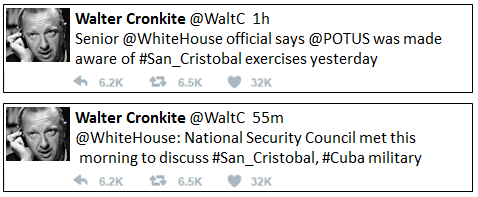
Two weeks ago, Professor David Rothkopf broadcasted a podcast about digital diplomacy. In the podcast he wonders, like many others, how past crises might have played out differently had digital tools been invented at the time. Such is the case with Cuban Missile Crisis of 1962 which often serves as an exemplar of crises management... Continue Reading →
Is the Backstage of Diplomacy Disappearing?
20th Century Diplomacy For most of the 20th Century, diplomacy was practiced behind iron curtains. While diplomats would often pose for photo opportunities, such photographs were taken before and after their meetings. The diplomatic deliberations themselves took place within the inner sanctums of great palaces or behind the closed doors of historic halls. It was... Continue Reading →
What is the Role of Former Ambassadors in Digital Diplomacy?
Ambassadors can serve as important digital diplomacy assets. Given their high profile, Ambassadors are often able to attract more social media followers than embassies. Additionally, given their extraordinary and plenipotentiary status as government representatives, their online comments soon find their way to media reports. Indeed, an Ambassadorial tweet can spark controversy, or add new opinions... Continue Reading →
What’s in a Tweet? The Case of Benjamin Netanyahu and the Mexican Wall
Yesterday evening I was interviewed on an Israeli radio show regrading a recent tweet published by Israeli Prime Minister Benjamin Netanyahu. In this tweet the PM argued in favour of the construction of a wall between the US and Mexico. As usual, I was asked “What’s in a Tweet?”, or how much information can we... Continue Reading →
Poland’s #Selfie Diplomacy
On January 23, 2017, the Polish Embassy in the US published a YouTube video titled “Words Matter”. The video aims to ensure that journalists and social media users employ the correct term when referring to concentration camps built by Nazi Germany on Polish soil during World War 2. This video serves as a fascinating example... Continue Reading →