A newspaper article published last week announced that the “US plans to boost tech diplomats deployed to Embassies”. The plan would see the State Department deploy a diplomat “trained in tech issues” to each of its 168 embassies. US diplomats stated that there was an urgent need to get diplomats with tech expertise into the... Continue Reading →
The EU’s Digital Response to #COVID19
Since it first migrated outside China, the Corona virus has dominated news cycles as pundits offer the public a variety of doomsday scenarios. This was true even before the virus crippled Italy or left many dead in Spain. The Corona virus makes for good ratings for several reasons. First, during the 20th and 21st century... Continue Reading →
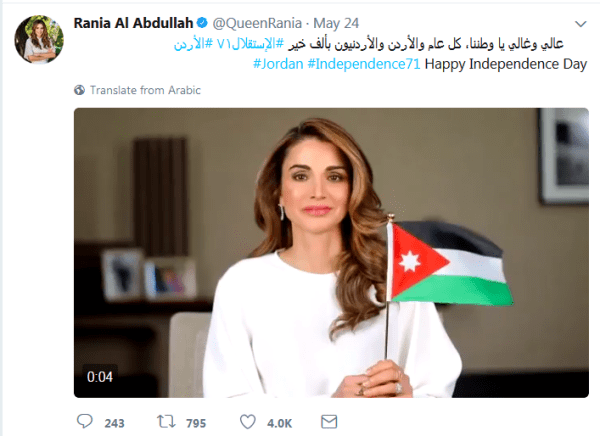
Queen Rania’s Selfie
Introduction The Arab World has always had a strenuous relationship with social media. On the one hand, several countries in the Arab World monitor their citizen’s social media activity, ban social media or shut down social media during times of domestic upheaval. Such was the case when the Mubarak regime attempted to block Facebook at... Continue Reading →
The Personalization of Digital Diplomacy
In the early days of digital diplomacy, MFAs and diplomats viewed social media as linear communication tools. Diplomats believed that they could use social media to craft a message and directly disseminate it among online publics. Thus, social media was no different from other mass media such as the radio and television. Yet as the... Continue Reading →
The Digitalization of Diplomacy: Toward Clarification of a Fractured Terminology
2017 marks a decade since the advent of “digital diplomacy”. What began as an experiment by a select number of foreign ministries has transformed into routine practice for diplomats and embassies the world over. To mark this occasion, I will be publishing a series of working papers. The goal of this series is to reflect... Continue Reading →
Workshop Summary- Towards Professionalization of #DigitalDiplomacy
On April 5th 2017, the Australian Embassy in Israel and the Oxford Digital Diplomacy Research Group co-hosted a workshop on Digital Diplomacy. The workshop, which was attended by journalists, foreign diplomats and members of the Israeli MFA (Ministry of Foreign Affairs), focused on three issues: utilizing digital tools for communicating with journalists, transitioning from digital... Continue Reading →
Do World Leaders attract #digital diplomats? 2016 analysis
Two weeks ago I evaluated the extent to which Donald Trump has been able to attract diplomats, MFAs, embassies and foreign affairs journalists to his Twitter account. My analysis suggested that most digital diplomats, and diplomatic institutions, do not follow Trump online. This week, I decided to expand my analysis and see if world leaders... Continue Reading →
Selfie Diplomacy- Analyzing Profile Pictures of World Leaders on Twitter
Last week I published an analysis of the Twitter profile pictures of MFAs (ministries of foreign affairs). I argued that such images may be a form of Selfie Diplomacy as profile pictures enable social media users to construct an online identity and communicate that identity to their networks. This week I endeavored to analyze the... Continue Reading →
Does Digital Diplomacy Blur All Boundaries?
This month, public diplomacy scholar Bruce Gregory published a new article in the Hague Journal of Diplomacy titled “Mapping Boundaries in Diplomacy's Public Dimension". In this article, Gregory explores the need to better define the boundaries between public diplomacy and other forms of diplomatic practice. Gregory makes an important point when asserting that “boundaries are... Continue Reading →
Palestine’s Online Line of Defence
As the violence between Israel and Palestine continued to escalate over the past week, both parties took to social media in order to offer their narrative of events. Last week I explored Israel’s official narrative by analysing tweets published by Israel’s MFA. What struck me most was the fact that Israel’s narrative seems to completely... Continue Reading →