Ambassadors can serve as important digital diplomacy assets. Given their high profile, Ambassadors are often able to attract more social media followers than embassies. Additionally, given their extraordinary and plenipotentiary status as government representatives, their online comments soon find their way to media reports. Indeed, an Ambassadorial tweet can spark controversy, or add new opinions... Continue Reading →
Open Letter to the ISA Leadership
To the leadership of the ISA, The events unravelling in the United States have led many members of the ISA to reevaluate their decision to attend this year's conference in Baltimore. Throughout my short academic career I have adamantly opposed academic boycotts, including those against my own country, Israel. This opposition stems not from my... Continue Reading →
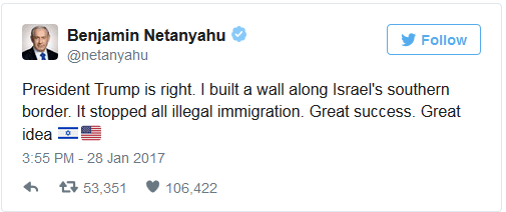
What’s in a Tweet? The Case of Benjamin Netanyahu and the Mexican Wall
Yesterday evening I was interviewed on an Israeli radio show regrading a recent tweet published by Israeli Prime Minister Benjamin Netanyahu. In this tweet the PM argued in favour of the construction of a wall between the US and Mexico. As usual, I was asked “What’s in a Tweet?”, or how much information can we... Continue Reading →
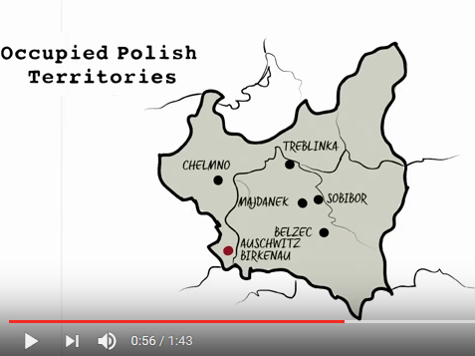
Poland’s #Selfie Diplomacy
On January 23, 2017, the Polish Embassy in the US published a YouTube video titled “Words Matter”. The video aims to ensure that journalists and social media users employ the correct term when referring to concentration camps built by Nazi Germany on Polish soil during World War 2. This video serves as a fascinating example... Continue Reading →
Is Post-Reality the Word of the Year in Digital Diplomacy?
In November of 2016, Oxford dictionary proclaimed “Post Truth” the 2016 word of the year. The choice was obviously a reflection of two important political campaigns- Brexit and the US Presidential elections. In both campaigns truth became subservient to political gains while the distinction between fact and fiction eroded. Exaggerations, fabrications and lies became an... Continue Reading →
On the use of images in the diplomatic struggle over Syria
Two weeks ago I published an analysis of the images of Syria used by the British FCO on Twitter. My analysis found that the FCO employs images that resonate with iconic moments from British history. In addition, I found that these images are an integral part of the British narrative of events in Syria. This... Continue Reading →
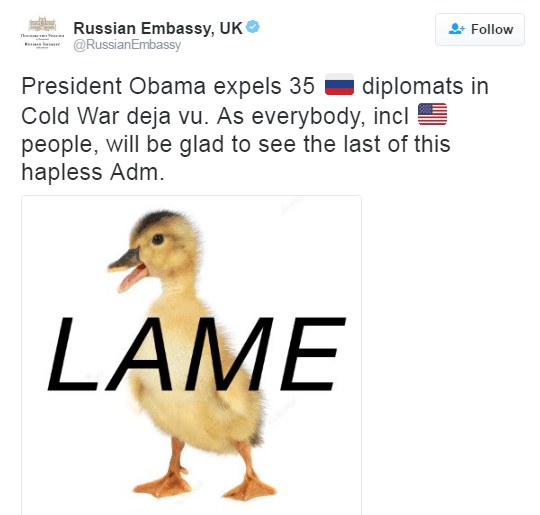
The Russian Tweet Heard Around the World
On Thursday, the 29th of December 2016, President Barack Obama announced the expulsion of 35 Russian diplomats from the US as well as new economic sanctions targeting Russia's intelligence agencies. Both measures were part of the American response to Russia's alleged interfering in the 2016 Presidential elections. Russia's digital response was immediate. Within an hour... Continue Reading →
On the use of narratives and images in Digital Diplomacy
Despite recent debates on fake news and the virility of rumors and gossip, it is important to remember that social media users are intelligent, curious and eager to learn about events shaping their world. More specifically, digital diplomacy followers are often interested in insight and analysis of global events. For this reason, narratives may play... Continue Reading →
Do World Leaders attract #digital diplomats? 2016 analysis
Two weeks ago I evaluated the extent to which Donald Trump has been able to attract diplomats, MFAs, embassies and foreign affairs journalists to his Twitter account. My analysis suggested that most digital diplomats, and diplomatic institutions, do not follow Trump online. This week, I decided to expand my analysis and see if world leaders... Continue Reading →
10 Tips to Increase ROI on #DigitalDiplomacy
On Friday, December 2nd, the Oxford Digital Diplomacy Research Group, and the Latvian Mission to Geneva, co-hosted a Digital Diplomacy event at the UN headquarters in Geneva. The purpose of the event was to examine whether there is a Return On Investment in digital diplomacy activities. The event demonstrated that the first stage of digital... Continue Reading →