
Digital diplomacy is now entering its third decade. Having emerged circa 2008 with the establishment of virtual embassies in virtual worlds, digital diplomacy now includes the use of diverse technologies ranging from social media to messaging applications, blogs, smartphone applications, big data analysis, coding, websites, and even crowdfunding, as recently used by Ukraine. For policymakers, the advent of digital diplomacy gave way to a relentless process of digitalization in which new technologies impact the norms, values, and working procedures of diplomats and diplomatic institutions. This relentless process has also demanded that diplomats understand and quickly adopt a succession of innovative technologies that now include generative AI, chatbots, and data-driven insight.
An important question that few scholars have addressed is what factors have shaped the digitalization of diplomacy over the last three decades. Has this process been shaped by the affordances of new technologies and diplomats’ desire to best leverage these technologies to obtain foreign policy goals? Has this been a strategic process, with MFAs carefully deciding which digital innovations to embrace and which to forgo? Has this been a top-down process, with MFAs driving the digitalization of diplomacy, or a bottom-up process, where diplomats’ digital experimentation and success stories shape how MFAs ultimately use technology? Or perhaps the digitalization of diplomacy has been shaped by power relations between states, diplomats, and big tech companies that reshape the landscape of international politics?
In a recent paper, Moran Yarchi and I studied the digitalization of diplomacy from a historical perspective. Our analysis suggests that the process of digitalization has been shaped by a confluence of events: a shock to the international system and the co-emergence of digital innovation. The rapid process of digitalization began in 2012 and was marked by diplomats’ use of digital technologies to create virtual ties by establishing virtual embassies, be it in the form of the virtual world Second Life or websites such as America’s Virtual Embassy to Iran. However, a confluence of events, the 2011 Arab Spring and the mass proliferation of SNS, led to a transition from “virtual diplomacy” to “digital diplomacy,” in which diplomats eagerly embraced SNS while establishing social media empires spanning hundreds of accounts and dozens of platforms.
Soon, another confluence of events, the 2014 annexation of Crimea and the use of digital disinformation, led to a further shift from “digital diplomacy” to “data diplomacy,” in which diplomats and MFAs used data analysis to identify and counter disinformation campaigns. This new form of diplomacy emerged with great urgency given the use of fake news, nefarious bots, and coordinated social media campaigns during the 2015 Brexit referendum and the 2016 U.S. elections.
The digitalization of diplomacy shifted yet again in 2020 thanks to another confluence of events: the external shock of the COVID-19 pandemic and diplomats’ use of virtual meeting platforms such as Zoom. True, Zoom was not an innovative technology in 2020, but it was innovative among diplomats who had long favored face-to-face meetings, which were viewed as key to establishing trust, rapport, and relationships among state representatives. Yet, amid quarantines and lockdowns, diplomatic negotiations increasingly took place virtually, leading to the practice of “Hybrid Diplomacy,” which blends virtual and physical diplomacy.
The year 2022 saw a fourth confluence of events with the external shock of the Russia–Ukraine War and a host of emerging digital practices and tactics. Indeed, ever since the war erupted, Ukraine has introduced a range of new digital tactics that were not previously part of digitalized diplomacy. These include the use of memes to rally online support for Ukraine and delegitimize Russia; the appointment of digital ambassadors who speak on behalf of Ukraine and help raise funds for weapons procurement and humanitarian aid; the creation of an IT Army that coordinates cyberattacks against Russia with hackers across the world; the creation of dedicated websites where visitors can “dronate” (a fusion of donate and drone) funds to Ukraine’s Army of Drones or purchase Ukrainian merchandise; and the use of social media to target big tech companies while calling on them to enact a technological boycott of Russia.
What is unique about this most recent confluence of events is that it does not consist of an external shock and the emergence of an innovative technology. Rather, it is marked by an external shock and the innovative use of existing technologies. Ukraine’s digital tactics reimagine how existing technologies may be used, ranging from social media platforms that host memes to websites dedicated to crowdfunding and messaging applications through which cyberattacks can be coordinated. This may be viewed as a form of “Tactical Diplomacy,” in which states fuse existing technologies with innovative tactics or new methods of achieving traditional foreign policy goals, such as legitimizing the use of force or rallying public support in favor of policy priorities.
The Digitalization of Diplomacy
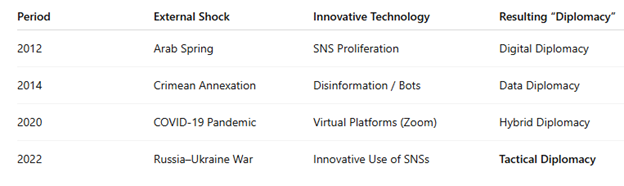
Crucially, “Tactical Diplomacy” rests on experimentation, is fast-paced as MFAs quickly adopt and abandon tactics, and spans multiple digital technologies. “Tactical Diplomacy” may include innovative uses of websites, blogs, bots, or automated software. It does not suggest a lack of strategic insight or planning; rather, it signals a new phase in the digitalization of diplomacy in which diplomats use their extensive digital know-how, accumulated over three decades, to quickly reconfigure how they use a given technology and to what end. Crucially, tactics that help diplomats achieve their goals are embraced, while tactics that fail to do so are rapidly discarded. Thus, this stage of digitalization rests not on a single technology or a single foreign policy goal, such as combating disinformation, but on multiple technologies and diverse policy objectives.
“Tactical Diplomacy” may also be applicable to the adoption of AI by diplomats. MFAs are already using AI to pursue various goals. Automation tactics may involve diplomats using generative AI to automate the drafting of press releases, the analysis of press coverage, and the preparation of speeches and addresses. Analytical tactics may see diplomats experimenting with AI-driven forecasting and data-driven insights to anticipate future shocks and crises. Tactics in which AI falls short will be abandoned. This is already evident in speechwriting, as many diplomats attest that AI-generated addresses often fail to make a strong impression. By contrast, tactics that augment diplomats’ capabilities are likely to be embraced, as has been the case with using AI to summarize press coverage.
The advent of “Tactical Diplomacy” is emblematic of digital maturity among diplomats and MFAs. Although the process of digitalization has been relentless, diplomats and MFAs now possess the skills and knowledge necessary to reimagine the use of existing technologies, to adopt and abandon tactics quickly, and to continually seek new ways of achieving traditional foreign policy goals.
 Exploring Digital Diplomacy
Leave a comment