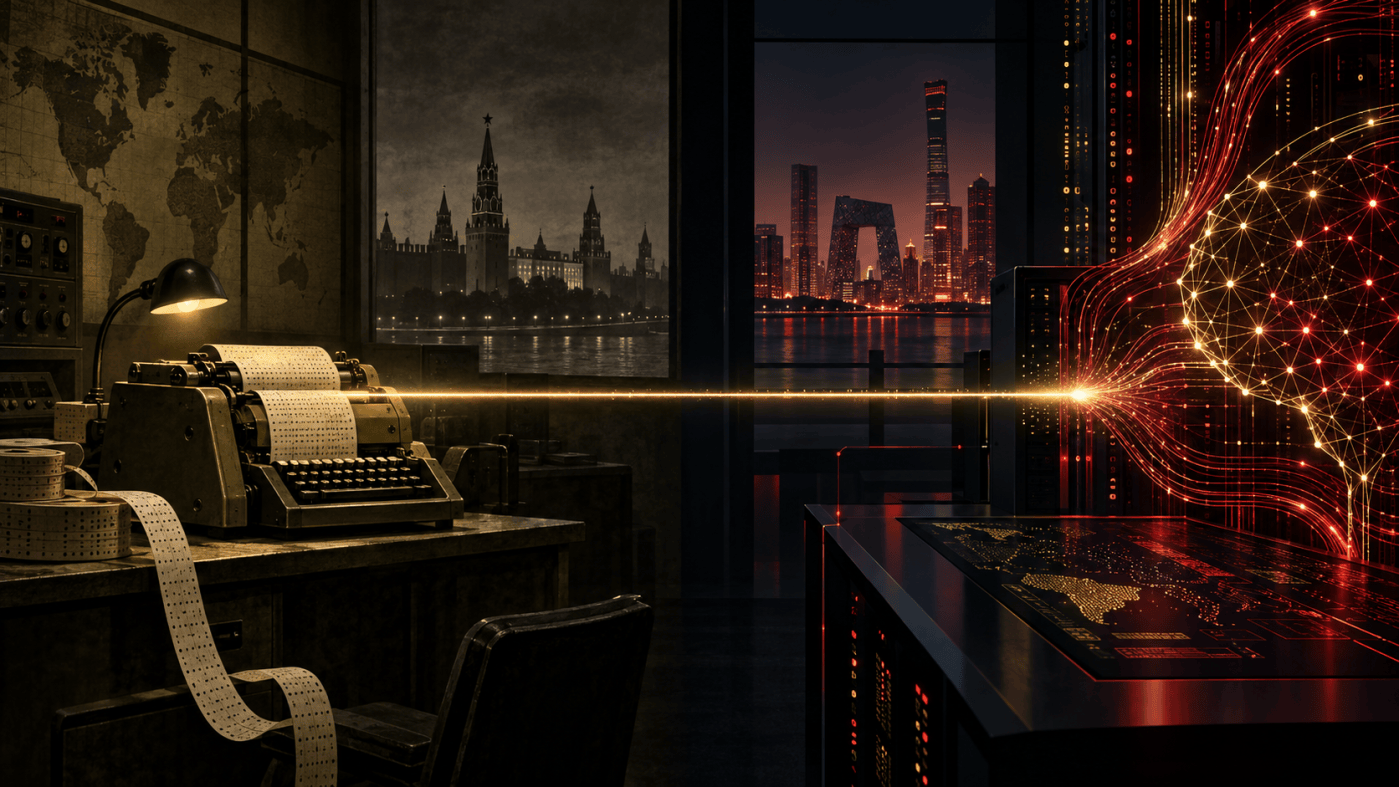
The Cuban Missile Crisis was one of the defining moments of 20th-century diplomacy. It was the closest the world ever came to a direct nuclear confrontation between two states, the closest the world ever peered into the abyss of nuclear annihilation, and the closest the world came to catastrophe due to a breakdown in communications between two world leaders. Throughout the crisis, US President John F. Kennedy and Soviet leader Nikita Khrushchev exchanged letters and signals. Yet they never directly spoke to one another, opening a window for miscalculation, misjudgement and miscommunication. The Crisis was ultimately averted thanks to direct back-channel talks between US and Soviet officials.
In June of 1963, just eight months after the Crisis, the US and the Soviet Union agreed to establish a direct communication line between Washington and Moscow, which became operational that August. The “hotline” was born of the sobering realization that military events unfold at a dizzying speed, a speed that far exceeds that of diplomacy and the exchange of letters via intermediaries. The two superpowers remained bitter rivals for decades to come. Yet they both recognized that a direct line of communication was not a gesture of friendship. It was an instrument of survival in a world governed by the nuclear logic of MAD, or Mutually Assured Destruction.
Last week, that logic returned. Speaking at the National Committee on U.S.-China Relations gala in New York, US Treasury Secretary Scott Bessent announced that the US and China are establishing a direct channel through which either nation can promptly alert the other to serious incidents involving advanced AI models. Both nations seem acutely aware that AI models, operating within split seconds, could now create a variety of crises that would require immediate and direct communication between Washington and Beijing.
The analogy to the Cold War “hotline” is instructive precisely because so much has changed. First, the nature of the threat has changed. The nuclear danger that haunted the skies of 1962 was, at its core, a danger of human miscalculation. Nuclear missiles, after all, did not launch themselves. The risk was that military officers, intelligence agencies or even national leaders would misread the actions of others and stumble into catastrophe. The AI era introduces a different risk in the form of systems that act at machine speed, whose behavior can surprise even their creators, and whose failures may not register as failures. An AI incident may look like an accident, a malfunction, or nothing at all, until its effects cascade through financial systems, infrastructures or information environments. The question the new “hotline” must answer is no longer only “what are your intentions?” but also “what just happened? Was that you? And did you mean it?”
AI incidents might take many shapes. An AI system embedded in military systems behaves erratically. For example, a swarm of drones patrolling a border may suddenly cross the border into another state and explode into buildings. Within minutes, the other side must determine whether it is witnessing an attack or an accident. A trading AI begins selling Chinese currency at massive scale, triggering a run on the yuan, or its trades cascade into a downward spiral spreading volatility across global financial markets. State authorities must swiftly deduce whether they face sabotage or a model faithfully pursuing its objectives. Or an AI system managing air traffic can suddenly fail, leading a country to suspend all air traffic, fueling rumors of cyberattacks and acts of war, creating a pressure point as leaders must respond quickly to a media frenzy and calls to arms.
Friday’s nationwide ground stop in the US was not an AI failure. Investigators traced it to aging communications equipment, and officials had to rule out a cyberattack as well. But it is not difficult to imagine a similar outage in which an AI system is the culprit, or merely the suspect. It is this ambiguity precisely that a direct channel is supposed to resolve. In none of these cases can a “hotline” between capitals prevent an AI failure. But it can offer a direct means of establishing whether an incident is deliberate, and of coordinating a response before ambiguity turns into escalation.
Second, it is interesting to note the new power dynamics between world powers. The 1960s “hotline” connected the US and the Soviet Union; the new one connects the US and China. At a symbolic level this illustrates China’s rise to the status of a superpower. At a practical level it draws the contours of the relationship that many believe will define the 21st century, that between American and Chinese presidents. The new “hotline” will also have a direct impact on Russia’s image, prestige and ability to exercise power. The “hotline” offers the image of a declining Russia relegated to a second-tier power.
Third, the Moscow-Washington “hotline” connected two superpowers that had accepted a condition of parity. Neither could destroy the other without being destroyed, and the “hotline” was meant to maintain this dangerous stalemate. The US-China “hotline” is being built under very different conditions, as both countries race towards AI supremacy. It is the race itself that is dangerous, as it may lead states to recklessly develop AI models and systems with little regard for safety, guardrails and testing. Thus, this new “hotline” is even more necessary than the old one.
The intensity of the AI race was evident a few days ago when Jensen Huang resigned as chief executive of Nvidia, the company whose chips power the global AI race, following media reports of an affair with a businesswoman who was reportedly acting as a spy for Beijing, an allegation that remains unconfirmed. Whatever the truth of that claim, the episode illustrates how the contest for AI supremacy is fought on many fields across many fronts.
For scholars of digital diplomacy, the announcement is especially important. Over the past two decades, digital diplomacy research has focused primarily on diplomacy’s public dimension, such as embassies’ use of social media, leaders’ use of X, and MFAs narrating crises in near real-time. The AI “hotline” suggests that in the future digital diplomacy research may focus on how states and leaders manage tech-related crises and the mechanisms created to manage such tech or AI-based crises.
The “hotline” is also reflective of a possible shift in the trajectory of digital diplomacy itself, where digital technologies are once again used to promote dialogue between states, as opposed to being used to sow discord and drive social tensions through disinformation. In this sense, the “hotline” might signal a return to the early vision of digital diplomacy, to a time when diplomats hoped that the digital age would be one of dialogue and not friction.


Leave a Reply