The past week has seen a series of violent protests erupt throughout France. What began as a series of protests by students over tuition fees and social inequalities spiraled into the most violent riots in recent French history. In cities across the country, police clashed with protestors, with hundreds of people being arrested. As city centers were engulfed in smoke due to the use of tear gas or the setting ablaze of historic buildings, the country was gripped by violence. Some argued that the protests were fueled by left-wing anarchists who hoped to overthrow the Republic. Others blamed disillusioned teenagers from French suburbs who used the protests to sow havoc, while still others laid the blame on Muslim immigrants who quickly turned to looting and stealing as a way of upending French society. Whatever the cause, news sites, WhatsApp groups and social media feeds were awash with images of burning buildings, French riot police and scenes of young people ransacking stores and bars.
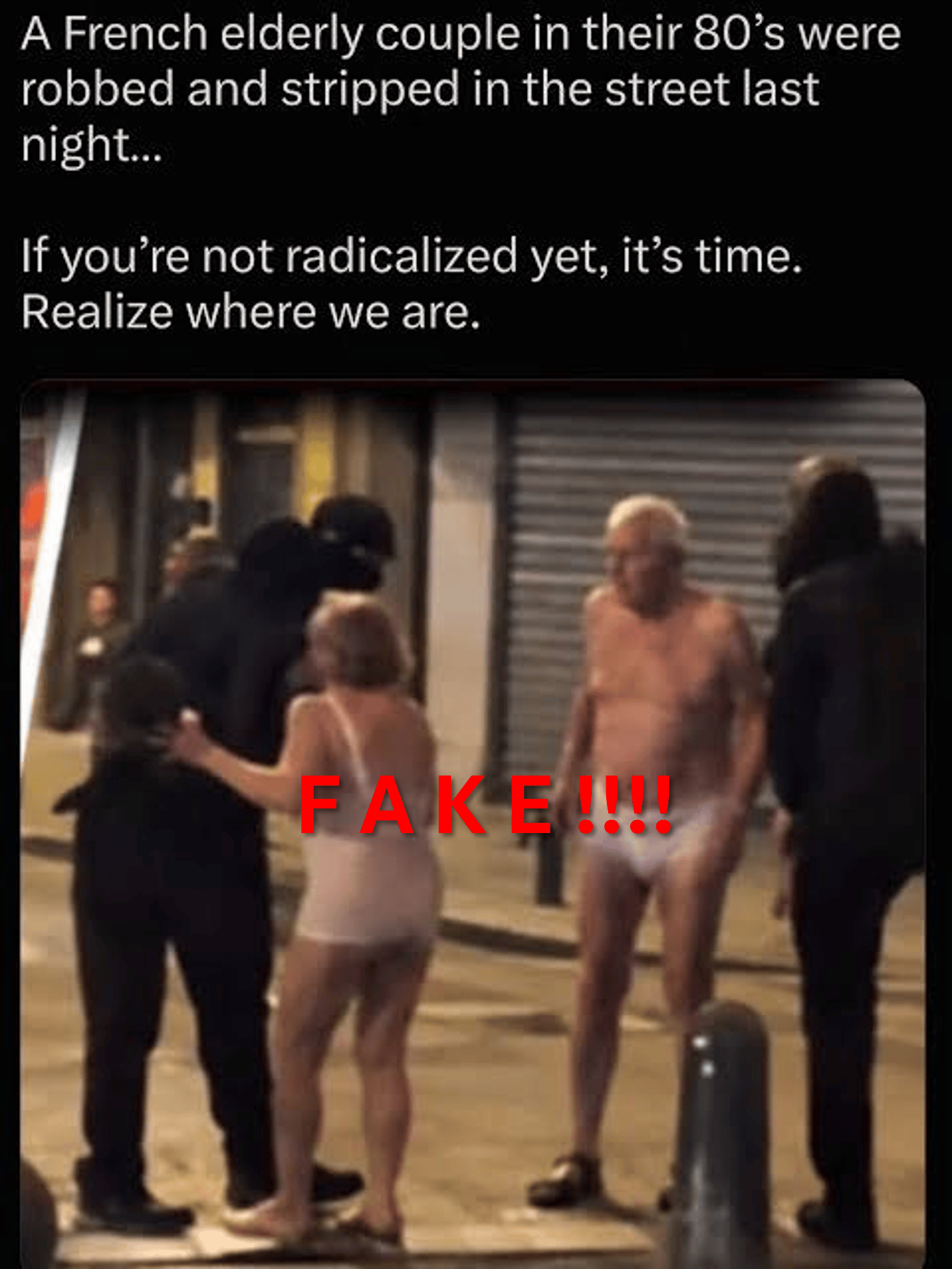
One image went viral across feeds and social media platforms. Shown below, the image depicts an elderly French couple being stripped and robbed by masked individuals. The old Frenchman stands bare in his underwear, watching as his wife is seemingly groped by a man. The woman, frozen in her nightdress, raises her hands in surrender. The image is one that centers on contrasts. The naked elderly couple surrounded by fully dressed rioters, the visible face and the alarm of the older man juxtaposed with the masked assailants, the white underwear accentuated by the black uniforms worn by the robbers, the immobility and tense posture of the older man contrasted with the tall, confident black figure standing beside him. The power of the image lies not in the suggestion that something horrid is about to happen but in the documentation of evil. It is an image of rape, or an unbearable violation of the most basic tenets of humanity and decency, as the old are preyed on by the young. It is an image that elicits a strong sense of moral outrage.
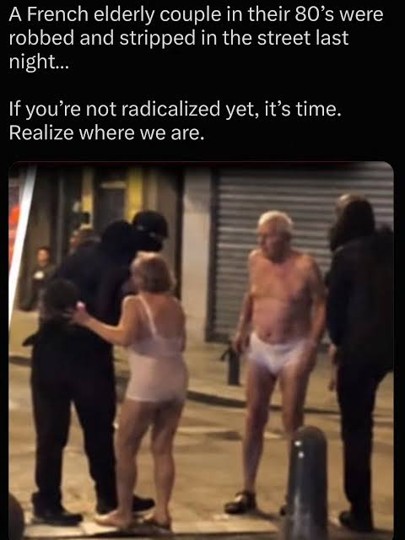
It is also a fake image; one created using Generative AI and circulated online with the aim of seizing the attention of social media users who are always busy scrolling from one image to the next. Before it was debunked, and even after, the fake image circulated widely online, posted and reposted by average users, news sites, influencers, political pundits and even veteran journalists. One senior Israeli journalist published the image on Twitter/X, writing, “I waited with this image as its authenticity is debated; yet it tells the story of France in one shot. An 80-year-old couple who during the ‘protests’ in Paris were undressed by the rioting mob. Pure evil. The death of shame. France is exposed and laid bare. It’s still not too late to fix France”.
Crucially, this AI image was published and given context by a variety of political groups. Right-wing users published the image as ‘proof’ of the anarchy that had gripped France; anti-migration groups invoked the image as ‘proof’ that young Muslims were raping and pillaging their way across Paris. Left-wing users reposted the image to ‘demonstrate’ that the protests were hijacked by right-wing thugs.
Outside of France, the image ‘bore witness’ to the costs of immigration, to the eradication of French culture, to the frenzy that has gripped youngsters disillusioned by failing democracies, to public contempt for the rule of law and the need to restore law and order, to the decline of Europe as a major world power as its elders are now mutilated in the streets, and even to the utility of police brutality, which can keep assailants at bay.
The picture is emblematic of the awesome power of Generative images and their potential impact on moments of crisis. The right viral image, circulated at just the right time, can inflame societies, sow discord, heighten tensions and polarize groups to the point of violence. Generative images, or images created using Generative AI, are especially powerful as they are meant to go viral. ChatGPT, Claude and the like all generate visuals ready-made for social media’s Attention Economy. Such images, by design, are meant to elicit a strong emotional response, be it positive or negative, as emotional activation summons attention and facilitates sharing. This is why Generative images serve as powerful disinformation tools, because disinformation is also rooted in emotional activation. When Russia used fake news stories and false websites ahead of its 2014 invasion of Crimea, it circulated horrid accounts of violence against Russian ethnic minorities. Russian trolls published a story alleging that pro-Ukrainian extremists prevented a doctor from rescuing people from a burning building in Odessa. Another story featured a pregnant woman strangled to death by pro-Ukrainian extremists, while other stories dealt with the supposed poisoning of water wells and the crucifixion of children.
The image of the elderly French couple is demonstrative of ‘Generative Outrage’, or the deliberate production and circulation of AI-generated visual content designed to provoke public anger, moral indignation, and political hostility by depicting fabricated or manipulated events. Unlike traditional disinformation, which seeks to convince publics that a particular claim is true, Generative Outrage transforms publics into witnesses of crimes, horrors and atrocities. Through these images, social media users are transformed into witnesses of events that never occurred and as witnesses they have a moral obligation to cry out against these fabricated events. It is the transformation of publics into witnesses that distinguishes ‘Generative Outrage’ from other forms of Deepfakes and AI-Generated images.
Moreover, Generative Outrage highlights the asymmetry between authentic images and authentic emotions, as a fabricated image can generate genuine feelings of grief, anger, rage, despair and demands for action. Generative images have real-world political consequences as they may generate demands for retaliation, support for the use of violence and greater hostility towards social groups such as minorities.
An artificial event, witnessed by many, can thus produce authentic moral outrage.
Historically, political actors have often sought to exploit real events to generate public outrage. Through selection, framing and emphasis, photos of events could be used to trigger public outcry. Yet in the age of Generative AI, political actors can fabricate visual evidence of atrocities or moral offenses and circulate them to provoke the same emotions that actual events might generate. The event itself is no longer a necessary component of the process.
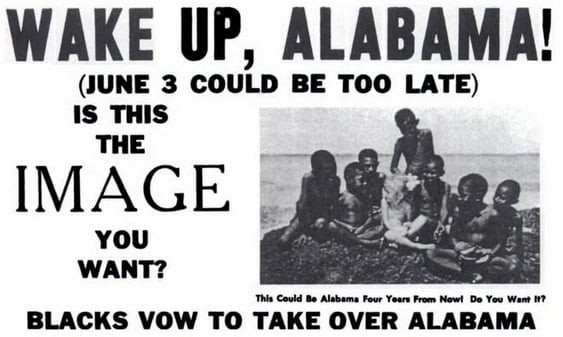
The power of such images lies in the fact that they cannot be unseen. They cannot be erased from memory, and with each recollection comes a tidal wave of emotions, so that a fake, AI-generated image lingers on long after it has been debunked. Consider the enduring power of the image below, circulated in the 1960s by US Governor George Wallace during one of his campaigns to suggest that the purity of white American girls would soon be violated by black men. It is an offensive image that, once seen, is seared into one’s memory.
Generative Outrage poses a new threat and a new kind of disinformation, as it cannot be countered by existing measures such as pre-bunking, debunking, factchecking and watermarking. Rather, it requires a new repertoire of visual responses where visuals correct or diminish the impact of other visuals. The repertoire of visual debunking will be explored in next week’s post.


Leave a Reply